 AllChinaBuy Spreadsheet Hat Rack
Hat Rack › Order costs on record
What an AllChinaBuy order cost, how it was paid, and the parcel cover it sold
Everything on this page is history. It comes from AllChinaBuy's help centre as it read on 4 August 2026 and from its own interface text archived in 2025 and early 2026. Its website has since been replaced by a maintenance notice, so none of this can be checked live, and nothing here describes what AllChinaBuy charges today.
A fee-free promise on a bill with three lines
AllChinaBuy's help article on how its agent service charged, archived on 4 August 2026, made the headline promise that ordinary shopping agent orders carried no handling fee beyond the item cost and shipping. The same article spelled out what the total actually was: the item cost, meaning the product price plus delivery from the seller to its warehouse, then the international shipping fee, then customs charges.
So a no service fee order still had three money lines and an optional fourth. Value-added services, such as extra photos or special packing, were paid on top at the buyer's choice. International shipping was calculated from weight, the shipping method and the destination. Customs charges were a declaration cost per parcel rather than duties, and they appear in the next section.
The words that matter are ordinary orders. The fee promise covered goods bought from the main marketplaces; orders from second-hand platforms carried their own charge, which the help article did not mention and the order form did.
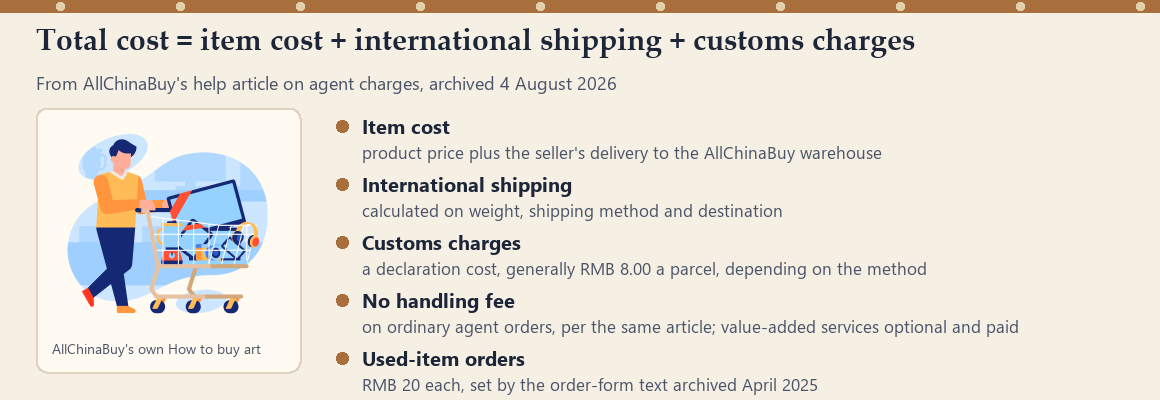
RMB 8 a parcel to declare, RMB 20 a used-item order
The help article put the customs declaration cost at generally RMB 8.00 a parcel, depending on the shipping method. That figure applied per parcel, not per item, which is one reason combining several caps and scarves into one parcel made sense: the declaration was paid once. It was a charge for preparing the declaration, not a tax.
Duties and any import taxes were a separate matter, set by the destination country and paid by the buyer, as they are with any agent. A parcel should be declared as what it really holds; this site gives no advice on declarations beyond that.
Used-item orders worked differently. AllChinaBuy's order-form text, archived in April 2025, charged a 20 RMB service fee on each order from a second-hand platform, and that fee included the standard warehouse inspection plus three detailed photos. The same text noted that sellers on second-hand platforms did not accept returns without a reason, so a used scarf or pair of frames bought this way could not go back for a change of mind.
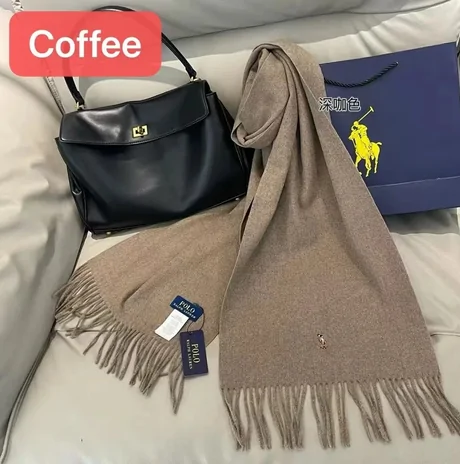
How AllChinaBuy took payment
Its user guide, archived on 4 August 2026, listed the payment methods at the step where a buyer settled the item price and the seller's domestic delivery: credit cards, WeChat, Alipay, Chinese debit cards and bank telegraphic transfer, with several currencies available. The site footer at the time carried card marks for Visa and Mastercard alongside Apple Pay and Google Pay.
Its payment interface text, archived in April 2026, adds detail the guide skipped. Card payments ran through PayPal, and PayPal converted currency automatically for non-USD payments. PayPal eCheck payments took three to seven days to clear and held up the order. For PayPal payments the delivery address was sent to PayPal as the billing address, and parcels where the two did not match went to manual review.
A typical order was paid twice: once for the items, and again for the international shipping deposit when the parcel was submitted. The deposit was based on estimated weight, and the final charge followed the carrier's measured weight.
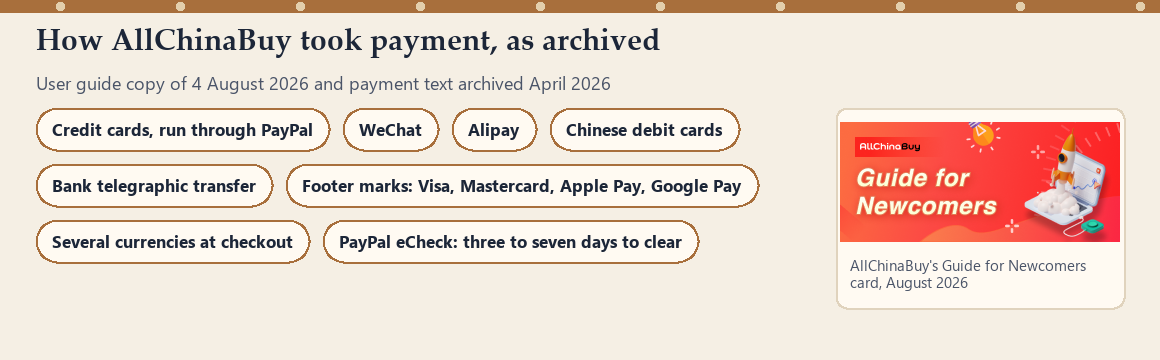
The exchange rate AllChinaBuy used, and why it differed
Prices on AllChinaBuy were set in yuan and shown in the buyer's currency. Its payment page text, archived in April 2026, said the platform rate followed the latest exchange rate published by ICBC and was adjusted regularly. The same text said the platform rate differed from real-time rates because of exchange rate fluctuation and cross-border handling fees.
That is a fair description of most agents' rates: a bank rate with costs built in, and it moves. What the text did not give was the size of the gap, and with the site down there is no way to measure it now. We print no markup figure for AllChinaBuy for that reason.
For any agent you use today the habit is the same: set the listing's yuan figure beside the checkout total in your own currency and work out the rate you are really paying. Paying in a currency your card account does not use can add a second conversion on the card side.
Bank transfer and wire charges on record
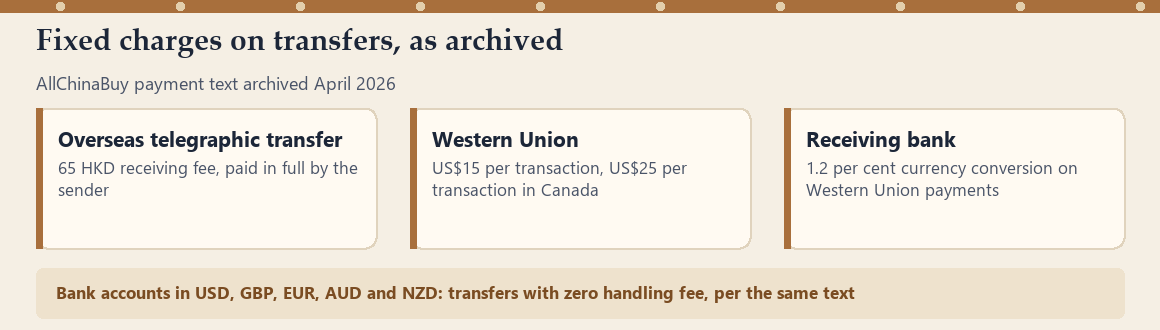
Large payments by bank transfer carried fixed costs. The archived payment text said an overseas telegraphic transfer incurred a handling fee of 65 HKD, which the sender had to pay in full so that the amount credited matched the amount due. Western Union payments carried a charge of US$15 per transaction, US$25 in Canada, and the receiving bank then took a currency conversion fee of 1.2 per cent.
The same text said bank accounts in USD, GBP, EUR, AUD and NZD offered transfers with zero handling fee, and at one point marked Western Union as temporarily out of service. For a small accessory order, fixed charges like these made card or wallet payment the cheaper route; a transfer only made sense for a large balance.
Parcel cover it sold, kept for reference
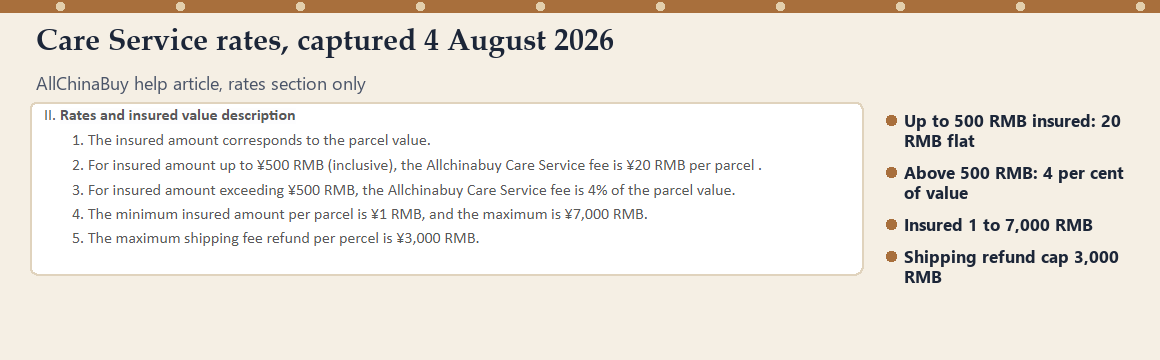
AllChinaBuy sold a paid parcel protection it called AllChinaBuy Care Service, chosen when the buyer submitted a parcel and paid along with the shipping fee. Its help article, archived on 4 August 2026, priced it in two bands. For an insured amount up to 500 RMB the fee was a flat 20 RMB per parcel; above 500 RMB it was 4 per cent of the parcel value.
The insured amount was meant to match the parcel value, with a minimum of 1 RMB and a maximum of 7,000 RMB per parcel, and the most it would refund for shipping was 3,000 RMB. The cover could be cancelled with a refund before the parcel left the warehouse; once the parcel shipped it could not be cancelled, and returned international parcels did not get the fee back.
For an accessories parcel the arithmetic was plain. Five caps and two scarves worth 400 RMB together paid the flat 20 RMB, which is a larger share of a small parcel than the 4 per cent charged above 500 RMB.
What the cover paid out, and how claims worked
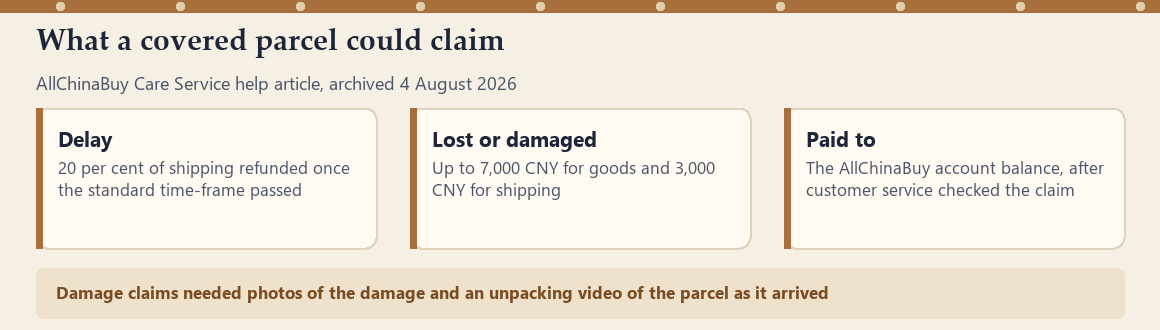
The same article described what a covered parcel could claim. If a parcel missed the standard delivery time-frame, the buyer received a 20 per cent refund on shipping fees, claimable once the time-frame had passed. For a lost or damaged parcel, compensation followed the actual situation up to a maximum of 7,000 CNY for the goods and 3,000 CNY for shipping fees. If a delayed parcel was later confirmed lost or damaged, the delay payment was deducted from the final amount.
Claims went through customer service, and approved payouts were refunded to the buyer's AllChinaBuy balance rather than to a card. A lost-parcel claim needed the parcel code, a screenshot of the transaction showing ownership and value, and a proof of loss from the carrier. A damage claim needed photos of the damage and an unpacking video of the parcel as it arrived; for electronics only external damage was accepted.
The unpacking video is the habit worth keeping with any agent. Film the parcel from sealed to open in one take before you inspect anything.
Goods the cover left out, jewellery included
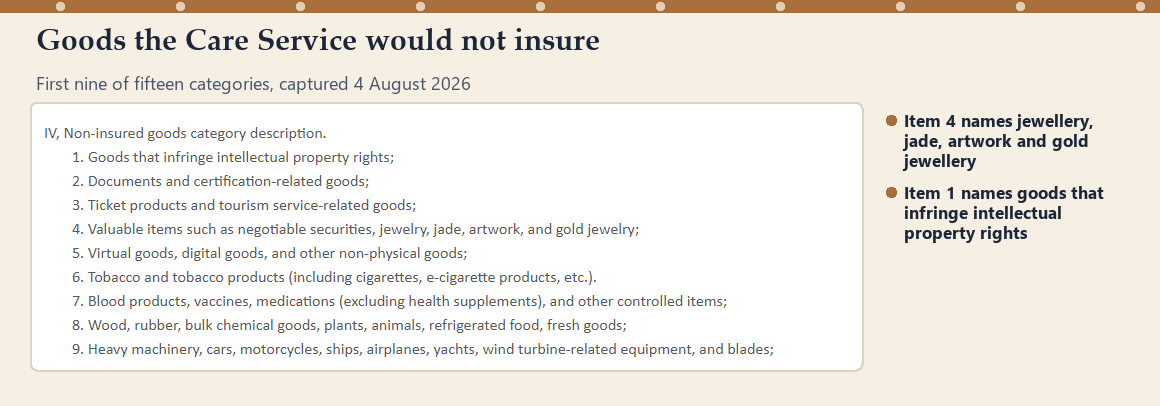
The article listed non-insured goods in fifteen categories. The first was goods that infringe intellectual property rights. The fourth matters most to this rack: valuable items such as negotiable securities, jewellery, jade, artwork and gold jewellery. A parcel of rings and chains could pay for cover that did not apply to its contents.
Other excluded categories ran from documents and tickets to tobacco, medicines, plants, chemicals and heavy machinery, most of which no agent ships to individuals anyway. A separate exclusions section refused compensation for force majeure, for claims the buyer could not support with proof, for damage caused by the buyer or the product itself, and for theft after delivery.
The claim deadline the article gave twice
Two deadlines appear in the same archived article. The claims section said a claim had to be filed within 30 days from the date the issue standard was determined. The exclusions section said no compensation was due if no inquiry or claim was made within 14 days after signing for receipt or reaching the claim time-frame.
The two are not obviously the same window, and the article did not reconcile them. We report both and do not pick one. With any agent's cover, the shorter of two stated deadlines is the one to work to: raise the problem with customer service the day you find it, and keep the date of your first message.
AllChinaBuy's cover is history now. The record page has the dated note on its homepage and what that notice told people with open orders.
Build a small-accessory budget without treating a card price as a total
The price tier on a pick is a way to browse the rack. It is not a delivered-price tier. A low-priced cap sent alone can have a very different total from the same cap added to a parcel you already planned.
Illustration, not an agent quote: if a selected accessory costs ¥88 and the seller quotes ¥7 domestic delivery, the goods-and-domestic subtotal is ¥95. That arithmetic tells you nothing yet about payment handling, conversion into your funding currency, optional warehouse services, international freight or import charges. Put those on separate lines instead of hiding them inside an assumed exchange rate.
| Budget line | Where to check it | When it becomes useful |
|---|---|---|
| Exact variant and domestic delivery | The seller option and imported agent order | Before the first payment |
| Conversion and payment charge | The funding or checkout screen for your method | Before confirming the payment |
| Extra inspection or packing | The agent’s current service choices | Before requesting the extra work |
| International freight and cover | The parcel quote and terms for the selected route | After the packed order can be estimated |
Insurance is a set of conditions, not a label
Read the present cover wording for the actual goods and route. Check exclusions, the covered value, what evidence a claim needs and when it must be submitted. Jewellery and watches deserve particular attention because a general parcel-cover description may not settle whether that item is covered. The archived exclusions above describe the old service; another agent may apply different terms.